
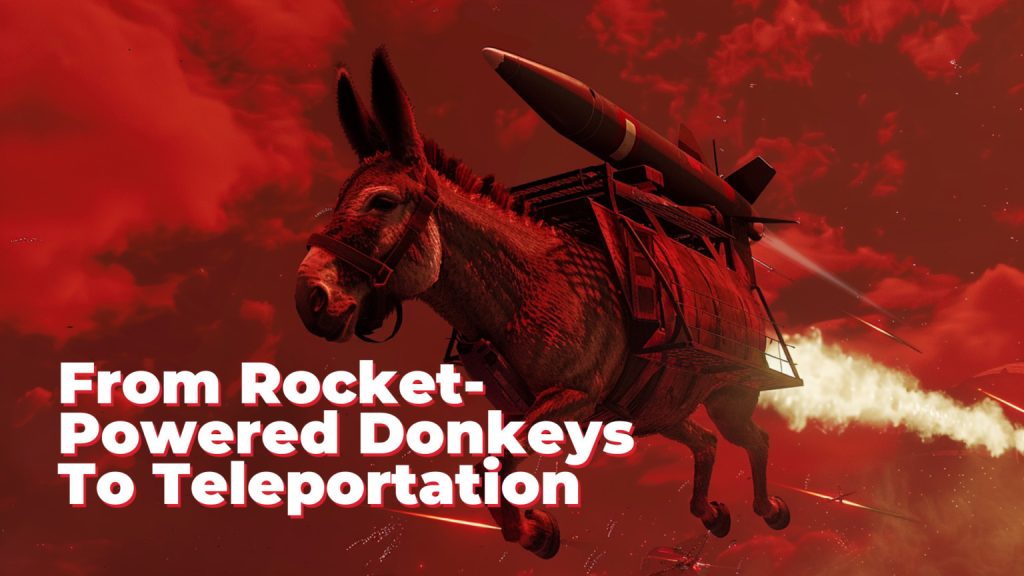
The Donkeys Dilemma
Here’s the deal: Donkeys are one of the earliest optimized systems on the planet. They’re sturdy, reliable, and get the job done. Sound familiar? That’s your current CRO process.
Now, when it comes to implementing AI in your CRO strategy, you’ve got two choices:
- Strap a rocket to that donkey.
- Genetically engineer a flying donkey.
Let’s break this down and see how it applies to the cutting-edge AI tech revolutionizing CRO.
Option 1: the rocket-strapped donkey (AI Augmentation)
This is when you use AI to supercharge your existing processes. It’s faster more powerful, but at its core, it’s still the same old donkey. Here’s what that looks like with modern AI:
1. Massive context windows: turbocharging your analytics
Think of this as strapping a supercomputer to your donkey’s brain. Models like GPT-4 and Claude 2 can now analyze entire user journeys, not just isolated interactions. It’s like giving your donkey the ability to remember every step of every journey it’s ever taken.
Practical application: Feed these models complete user sessions, from first click to conversion (or bounce). They’ll spot patterns you never knew existed, like how a user’s behavior on page 1 influences their actions on page 10.
2. Code generation and checking: auto-pilot for your donkey
AI isn’t just analyzing data; it’s writing and debugging code. Tools like GitHub Copilot are like giving your donkey a GPS and auto-steering.
Real-world use case: One CRO team used AI to generate 5,000 different button designs in a single day, complete with custom tracking for each variant. Try doing that manually without your donkey keeling over from exhaustion.
3. ChatGPT and Microsoft Copilot in the IDE: your donkey’s co-pilot
Imagine your donkey had a smart sidekick constantly offering advice. That’s what these AI assistants do in your development environment.
Productivity hack: Set up custom prompts in your IDE for common CRO tasks. Need a high-converting product description? Just type “/product-description” and let AI do the heavy lifting. It’s like teaching your donkey to respond to voice commands.
Option 2: the flying donkey (AI transformation)
This is where things get interesting. Instead of just speeding up your existing processes, you’re fundamentally changing how you approach CRO. You’re not just making a faster donkey; you’re creating a whole new beast.
Claude 3.5 Sonnet: your CRO shapeshifter
Anthropic’s latest model isn’t just a flying donkey; it’s a donkey that can transform into any animal you need. With its enhanced reasoning capabilities, it can tackle complex CRO challenges from multiple angles.
Pro tip: Use Claude 3.5 Sonnet for brainstorming sessions. Feed it your current conversion data and watch it spit out dozens of testable hypotheses, complete with rationales and potential pitfalls. It’s like having a roundtable discussion with the top CRO experts in the world but without the ego clashes.
Gemini’s no knowledge cutoff: your time-traveling donkey
Google’s Gemini model is like a donkey that can see into the future. It’s constantly learning, which means it’s always up to date on the latest CRO trends and consumer behaviors.
Strategy shift: Stop relying on quarterly reports. With Gemini-like models, you can adjust your CRO strategy in real-time based on global trends and your site’s performance. It’s like having a donkey that can predict where the grass will be greenest tomorrow.
Multimodal AI: your donkey’s sixth sense
The latest AI models can analyze text, images, and even video simultaneously. This isn’t just a flying donkey; it’s a donkey with X-ray vision, infrared sensing, and mind-reading capabilities.
Cutting-edge example: An e-commerce site used multimodal AI to analyze product images alongside user behavior data. The AI suggested subtle changes to image composition that increased add-to-cart rates. It’s like your donkey telling you which apples in the orchard taste the best just by looking at them.
The plot twist: when you ask for a flying donkey and get teleportation
Here’s where it gets wild. Sometimes, when you ask AI for a flying donkey, it gives you teleportation instead. In other words, AI might propose solutions that are so innovative that they completely redefine the problem you are trying to solve.
Real-world example: I once worked with a client who wanted to use AI to optimize their checkout process. They were thinking about things like button placement, form field optimization – you know, the usual suspects. But when we fed their data into our AI system, it came back with something completely unexpected.
Instead of tweaking the checkout, the AI suggested implementing a subscription model with automatic renewals. This completely eliminated the need for repeated checkouts for returning customers. Conversions skyrocketed, and Customer Lifetime Value (CLV) went through the roof.
That’s the power of AI in CRO. It doesn’t just solve the problem you present – it can redefine the problem entirely. You thought you were getting a flying donkey, but you ended up with teleportation.
The evolution of market growth: from donkey cart to rocket ship
Let’s break down the numbers to show you exactly what happens when you evolve from a regular donkey to a teleporting super-donkey.
We’ll look at a hypothetical scenario with a Customer Acquisition Cost (CAC) of $100 and a Lifetime Value (LTV) of 2x:
Q1 (Your basic donkey):
- Operational cost: $10M
- Advertising budget: $3M
- Customers acquired: 30,000
- Revenue: $6M
Q2 (Donkey with a saddle upgrade):
- Operational cost: $9M
- Advertising budget: $4M
- Customers acquired: 40,000
- Revenue: $8M
Q3 (Rocket-strapped donkey):
- Operational cost: $8M
- Advertising budget: $5M
- Customers acquired: 50,000
- Revenue: $10M
Q4 (Full-on teleporting super-donkey):
- Operational cost: $6.5M
- Advertising budget: $6.5M
- Customers acquired: 65,000
- Revenue: $13M

The opportunity cost of not optimizing and automating processes? A whopping $7,000,000. That’s right, seven million dollars left on the table if you’re still riding that basic donkey.
This isn’t just about saving money on operational costs. It’s about freeing up resources to invest in growth. As you automate and optimize with AI, you can shift more budget to advertising, acquire more customers, and drive more revenue. It’s a virtuous cycle that only AI-powered CRO can deliver at scale.
Look at that Q4 number again. By implementing AI and automation, you’ve:
- Cut operational costs by 35%;
- More than doubled your advertising budget;
- Increased your customer base by 117%;
- Boosted revenue by 117%.

And this is just the beginning. Once your AI systems start learning and optimizing in real-time, the sky’s the limit. Or should I say, the universe is the limit because we’re talking about teleporting donkeys here.
The numbers don’t lie: a case study in AI-powered efficiency
Let’s talk cold, hard cash. One experimentation agency (who I won’t name, but you know who you are) implemented an automated system for asset creation and task management. The result? They saved their clients $2,687,070 in admin work from one automation path alone.
Here’s the breakdown:
- Experiment ideation: AI guides users through inputting ideas, hypotheses, and problem statements.
- Automated prioritization: An algorithm scores and prioritizes experiments.
- Asset creation: The system generates branded assets for presenting ideas.
- Task distribution: Templated tasks are automatically assigned to the right people.
- Automated task reporting: Task status changes in ClickUp automatically update the data layer in Airtable.
- Automated stakeholder updating: The system keeps everyone in the loop without manual intervention.
The math: 300 (billable hourly rate) x 4.3 (avg time saved from automation) x 2083 (avg number of experiments run per year) = $2,687,070
That’s not chump change. And remember, this is just from one automation path. Imagine the savings when you implement AI across your entire CRO process. It’s like upgrading from a single donkey to an entire fleet of teleporting super-donkeys.
Challenges? Sure, but they’re manageable.
Nothing worth doing is easy. Here are the speed bumps you might hit:
- Data quality: Garbage in, garbage out. Make sure your data is clean and comprehensive.
- Complexity of AI systems: Implementing AI isn’t plug-and-play. You need expertise or a solid partner.
- Loss of human touch: Don’t let AI make you forget the human element in marketing.
- Ethics and privacy concerns: With great data comes great responsibility. Don’t be creepy.
- Unpredictable costs: AI implementation can have hidden costs. Budget carefully.
The bottom line: evolve or extinction
The AI revolution in CRO isn’t coming. It’s here. And it’s separating the leaders from the laggards faster than you can say “statistical significance.”
If you’re not leveraging these AI advancements in your CRO efforts, you’re not just leaving money on the table – you’re leaving $7 million on the table, along with your entire wallet, your car keys, and probably your pants too.
The choice is simple: Embrace AI, turn your donkey into a teleporting super-beast and dominate your market. Or stick to your old ways and watch your competitors zoom past you at warp speed while you’re still trying to figure out which end of the donkey to feed.
What’s it gonna be? Are you ready to teleport, or are you comfortable being left in the dust?
Interested in learning more about conversion rate optimization from the best in the business? Choose from a wide range of courses!